


What Is S.A.F.E.T.E.C.H
S.A.F.E.T.E.C.H. is Earth Care Rent A Tech's professional-readiness training and assessment program for independent contractors, tradespeople, service professionals, and other members of the modern independent workforce.
The program was created around a simple question:
If consumers increasingly trust independent workers with their homes, belongings, transportation, meals, businesses, and families, shouldn't professional readiness mean more than downloading an app and passing an identity check?
We believe it should.
S.A.F.E.T.E.C.H. combines structured training, professional-readiness education, scenario-based learning, and a live oral assessment covering safety, ethics, communication, business fundamentals, sustainability, Earth Care procedures, and modern workforce readiness.
Its curriculum incorporates educational and professional material drawn from more than 90 academic, government, safety, workforce-development, professional, and industry sources.
The curriculum incorporates material from 90+ sources and references spanning subjects such as:
-
Workplace and occupational safety
-
Professional ethics
-
Customer communication
-
Service quality
-
Financial literacy
-
Independent-contractor business skills
-
Workforce development
-
Employability and soft skills
-
Sustainability
-
Artificial intelligence and digital readiness
-
Career planning
-
Professional assessment
-
Microcredential design
-
Training effectiveness
-
Authentic and scenario-based assessment
The goal is not to require workers to memorize a collection of facts.
The goal is to develop and assess professional judgment
Why We Use an Oral Phone Assessment
Online testing is convenient.
It also creates an obvious challenge.
When an assessment is completed privately on a computer, it can be difficult to determine whether the person answering the questions actually knows the material or is searching for answers elsewhere.
S.A.F.E.T.E.C.H. therefore uses a live, proctored oral assessment.
The assessor speaks directly with the applicant.
Questions are administered during the call.
Outside assistance and reference materials are prohibited.
Applicants must explain their answers verbally.
The assessor may repeat a question or clarify unfamiliar wording when necessary, but cannot coach the applicant, identify the correct lesson, or provide hints that reveal the answer.
This does not make any assessment system impossible to defeat.
What it does is create meaningful assessment controls intended to make the credential more difficult to obtain through simple answer-copying or automated assistance.
If earning the credential requires demonstrating knowledge, protecting the integrity of that assessment matters.
Is S.A.F.E.T.E.C.H Just A Earth Care Certification?
No the program is no longer documented only inside Earth Care.
The design of S.A.F.E.T.E.C.H. has been formally described in a scholarly program-design article published in the peer-reviewed journal Stout in Business and Management:
“From Platform Orientation to Professional Readiness: Design of the S.A.F.E.T.E.C.H. Microcredential for Independent Contractors and Service Professionals.”
The publication examines the credential's curriculum architecture, transferable-learning model, oral assessment structure, quality-assurance considerations, and potential role in preparing independent workers for modern professional environments.
What Does the Peer-Reviewed Publication Mean?
Peer review matters because scholarly publication requires ideas, methods, and conclusions to be presented in a form that other knowledgeable readers can examine and evaluate.
The S.A.F.E.T.E.C.H. program-design article describes the reasoning behind the credential, its curriculum structure, its assessment model, the distinction between transferable and organization-specific learning, its limitations, and areas requiring future study.
That is important.
S.A.F.E.T.E.C.H. is not presented merely as a marketing slogan.
Its underlying design has been documented publicly in scholarly literature, providing researchers, workers, consumers, platforms, educators, and other organizations with a way to examine what the credential is intended to measure and how the model was constructed.

Why the Gig Economy Should Care
Think about how much trust consumers place in independent and gig workers every day.
They deliver food our families eat.
They transport people to airports, workplaces, schools, appointments, and hospitals.
They enter homes to make repairs, assemble furniture, clean, move belongings, install equipment, maintain property, and complete countless other services.
Yet the modern gig economy still has a significant professional-readiness gap.
Every platform creates its own system.
One may perform a background check.
Another may verify identity.
Another may provide a short safety video.
Another may rely primarily on customer ratings.
And when a worker moves from one platform to another, much of the professional reputation and training that worker developed may effectively start over.
S.A.F.E.T.E.C.H. was created around the idea that professional readiness should become more portable.
Background screening can be extremely important.
Identity verification can be important.
Occupational licenses can be essential.
Customer ratings can provide valuable information.
But each answers a different question.
A background check may help answer:
“Is there something in this person's history we need to know?”
Identity verification answers:
“Is this person who they say they are?”
A trade license may answer:
“Has this person met a particular legal or technical licensing requirement?”
A customer rating may answer:
“Were previous customers satisfied?”
Professional-readiness training asks something different:
“How should this person conduct themselves when working independently with members of the public?”
How should a professional respond when a customer becomes upset?
What should happen when an unsafe condition appears?
How should additional work be discussed?
How should a worker communicate a mistake?
When should someone refuse work outside their qualifications?
How should customer property and confidential information be treated?
What does honest pricing look like?
How should independent workers think about expenses, profitability, taxes, scheduling, documentation, and customer expectations?
Those are not exclusively Earth Care questions.
They are gig-economy questions.
Why This Matters for the Future of Gig Work
The gig economy has spent years perfecting technology that can connect a customer with a worker in seconds.
Perhaps the next stage should focus just as intensely on the professional preparation of the person who arrives.
Consumers deserve meaningful trust signals.
Workers deserve ways to demonstrate that they take their profession seriously.
Platforms deserve stronger professional-readiness frameworks.
And independent workers deserve professional achievements that do not necessarily disappear simply because they move from one app to another.
Technology made the workforce portable.
We believe professional readiness should become portable too.
That is the larger vision behind S.A.F.E.T.E.C.H.
Learn. Grow. Stand Out.
Why Gig Workers Should Care about Earth Care's S.A.F.E.T.E.C.H
Independent workers increasingly move between platforms, customers, employers, contract opportunities, and their own businesses.
A worker might perform home services today, accept independent contract work next month, pursue an apprenticeship later, and eventually operate a business of their own.
Platforms change.
Customers change.
Jobs change.
But fundamental professional skills travel with the worker.
Safety travels.
Ethics travel.
Communication travels.
Professionalism travels.
Financial understanding travels.
Customer service travels.
Honesty travels.
S.A.F.E.T.E.C.H. is designed to recognize and strengthen that broader professional foundation.
The credential gives participating Pros another way to demonstrate that they have completed structured professional-readiness training and successfully completed an assessment covering the program's required competencies.
Your Professional Identity Should Be Bigger Than One App
Every gig platform will always need its own policies, procedures, eligibility requirements, screening systems, and specialized training.
S.A.F.E.T.E.C.H. does not attempt to eliminate those differences.
Instead, its architecture separates transferable professional-readiness concepts from organization-specific procedures.
Approximately 70% of the current assessment addresses broader professional-readiness areas, while approximately 30% concerns Earth Care-specific procedures.That structure creates an interesting possibility.
An outside organization adopting a similar framework could replace Earth Care-specific content with training relevant to its own platform while preserving a common professional foundation.
A food-delivery platform might emphasize food integrity, delivery procedures, customer interaction, and platform rules.
A rideshare platform might incorporate passenger interaction, incident response, vehicle expectations, and platform procedures.
A home-services marketplace could emphasize property protection, scope boundaries, safety, communication, and customer service.
Different industries need different operational content.
Professionalism itself does not need to be reinvented every time.
What If Professional Readiness Could Travel With the Worker?
S.A.F.E.T.E.C.H. began inside Earth Care Rent A Tech.
We do not believe its potential has to end there.
Imagine an independent worker being able to tell a platform, employer, or customer:
“I completed an assessed professional-readiness program covering safety, ethics, communication, customer service, business fundamentals, professionalism, and modern independent-work skills.”
The worker may change platforms.
The worker may change industries.
The worker may eventually build a company.
But the professional foundation remains relevant.
That is the long-term idea behind a portable gig-economy microcredential.
Not another meaningless digital badge.
Not a substitute for licensing.
Not a guarantee that somebody will never make a mistake.
A credible, assessable professional-readiness foundation for a workforce that increasingly moves between platforms.


Why Consumers Should Care
Better Trust Requires More Than Stars
Five-star reviews matter.
Background checks matter.
Licenses matter where required.
Experience matters.
But consumers increasingly make decisions about strangers through a screen.
S.A.F.E.T.E.C.H. is intended to provide another piece of information:
Has this person completed professional-readiness training and demonstrated understanding of the standards being taught?
It does not promise that a credential holder will never make a mistake.
No responsible credential can make that promise.
Instead, it provides evidence that the individual has completed a defined program addressing professional behaviors and has been assessed on that material.
For consumers placing trust in independent workers, we believe that distinction matters.
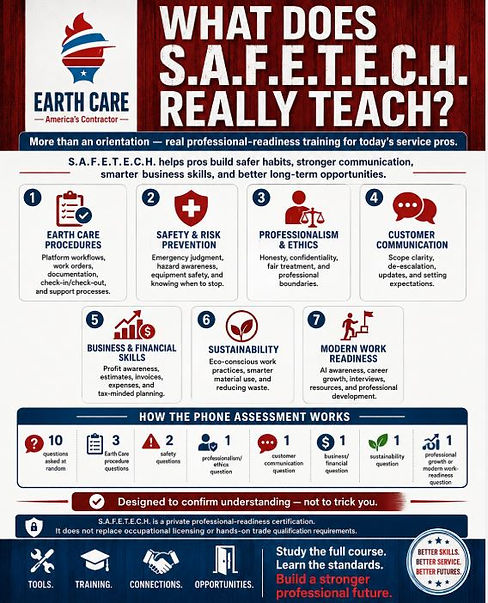
What S.A.F.E.T.E.C.H. Teaches
Company Procedures
Pros learn how Earth Care work orders operate, including check-in and check-out procedures, work documentation, additional-work requests, materials, payment concerns, support resources, and platform procedures. These can be customized to your organization
Safety and Risk Prevention
Training covers hazard recognition, emergency judgment, electrical and gas concerns, damaged equipment, unsafe customer requests, property incidents, and recognizing when work is outside a professional's qualifications.
Professionalism and Ethics
Pros review honesty, confidentiality, responsible pricing, customer boundaries, accurate representations of experience, respectful conduct, accountability, and ethical decision-making.
Customer Communication
Training addresses scope clarification, expectations, delays, additional work, written communication, difficult conversations, customer concerns, and de-escalation.
Business and Financial Skills
Topics include gross versus net income, expenses, tax planning, tool replacement, job profitability, estimates, invoices, written approval for project changes, and other fundamentals of operating independently.
Sustainability
Pros learn practical approaches to reducing waste, considering durable materials, reusing or recycling appropriate materials, and discussing environmentally responsible options with customers.
Modern Work Readiness
Training includes responsible use of artificial intelligence, interviewing, professional goals, workforce resources, networking, apprenticeships, professional branding, and independent-business development.

Assessment Integrity Matters
You Do Not Earn S.A.F.E.T.E.C.H. Simply by Watching a Video
A credential has little meaning if everybody automatically receives it.
That is why S.A.F.E.T.E.C.H. includes a live oral assessment administered over the phone by an Earth Care assessor.
The assessment is designed to determine whether the applicant understands the assigned material and can explain important concepts without simply copying answers from a screen.
Applicants may not use:
-
Training notes
-
A printed study guide
-
Another phone or device
-
Search engines
-
Artificial intelligence
-
Another person
-
Outside reference material
-
Prewritten answers
The assessor administers the examination live and evaluates the applicant's responses during the call.
This approach creates a substantially different assessment environment from an unproctored multiple-choice quiz where answers can simply be searched online or copied from another device.
We want the credential to represent demonstrated understanding — not access to Google.
Approximately 240 Possible Questions
The S.A.F.E.T.E.C.H. assessment bank currently contains approximately 240 possible questions based on the assigned training.
Applicants do not receive all 240 questions.
Instead, each assessment contains 10 questions selected from the larger question bank using a defined assessment blueprint.
Individual applicants may therefore receive different questions while still being assessed across the same major competency areas.
Every Test Follows the Same Competency Structure
Each 10-question assessment currently includes:
-
3 questions — Earth Care procedures
-
2 questions — Safety and risk prevention
-
1 question — Professionalism and ethics
-
1 question — Customer communication
-
1 question — Business and financial skills
-
1 question — Sustainability
-
1 question — Professional growth and modern work readiness
This structure is intended to prevent an applicant from passing solely because they happen to know one subject particularly well.
The assessment samples across the broader curriculum.
Understanding Matters More Than Reciting
The S.A.F.E.T.E.C.H. assessment is not primarily an acronym or telephone-number memorization exercise.
Some Earth Care procedure questions may require specific operational knowledge because participating Pros need to understand how the platform works.
Most of the assessment, however, addresses broader professional-readiness concepts.
Applicants are not necessarily required to repeat course language word for word.
A response can be accepted when the applicant accurately communicates the required action, underlying principle, and professional reasoning.
The objective is to determine whether someone understands what to do, when to do it, and why it matters.
